Best budget smart trainer 2026: what I'd actually buy
 By Jack, Jack's Coaching
Updated 7 November 2026
The ThinkRider X2 Max buttons on this page are affiliate links. If you buy through them I may earn a small commission at no extra cost to you. I've ridden the X2 Max, the original Wahoo KICKR Core and an Elite Chrono fluid trainer. I haven't ridden the XX Pro, KICKR Core 2, Van Rysel D100 or Zwift Hub: those sections use spec sheets and other reviewers' testing, and I name them.
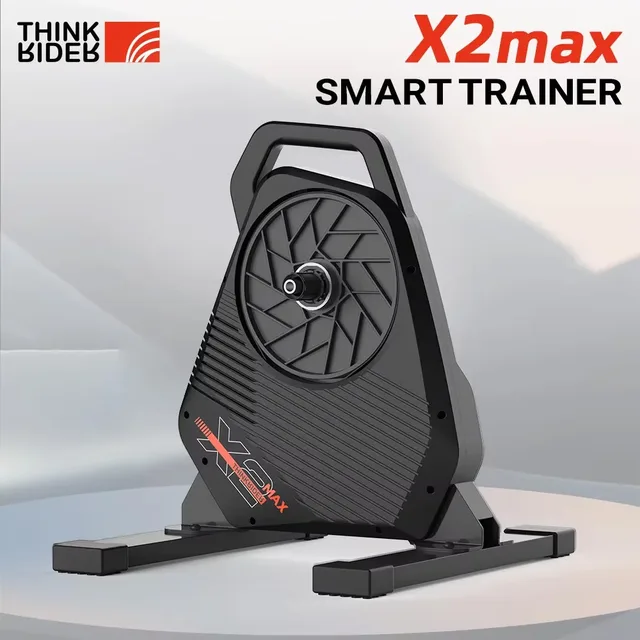
The best budget smart trainer for most people is the ThinkRider X2 Max: direct drive, 2,000 W and 18% gradient for about US$220 on AliExpress. It's the one I ride. The catch: no cassette in the box, and some owners find it reads a little high. Need Zwift virtual shifting? Get the Wahoo KICKR Core 2 (US$549.99).
You don't need US$1,000 to train indoors properly. A direct-drive trainer that sets its own resistance, runs ERG workouts and simulates climbs now starts at about US$220.
Go cheaper and you're buying compromises: a 600 W ceiling, a 6% max climb, or a wheel-on trainer chewing through your tyre.
I've owned a Wahoo KICKR Core and an Elite Chrono fluid trainer, and now I ride the ThinkRider X2 Max. Below are the five budget smart trainers worth looking at in 2026, plus the questions people actually ask before buying one: noise, apartments, Zwift and what else you need.
trainer for most people
Buy the ThinkRider X2 Max if you want the most trainer for the least money. Get the KICKR Core 2 if you want a big brand, a cassette in the box and Zwift virtual shifting. Get the Van Rysel D100 if you live near a Decathlon and you'll never push past 600 W.
How do the budget smart trainers compare?
The ThinkRider X2 Max gives you the most power and gradient per dollar, while the KICKR Core 2 and Van Rysel D100 are the ones to look at if you want Zwift virtual shifting.
| Typical price | Max power | Max gradient | Claimed accuracy | Cassette in the box | Zwift virtual shifting | |
|---|---|---|---|---|---|---|
| ThinkRider X2 Max | About US$220 | 2,000 W | 18% | ±2% | No | No |
| ThinkRider XX Pro | About US$360 | 2,500 W | Also simulates descents | ±1% | No | No |
| Wahoo KICKR Core 2 | About US$550 | 1,800 W | 16% (down to -10%) | ±2% | Yes, 11-speed 11-28 (US) | Yes |
| Van Rysel D100 | €249 to €299 / £260 | 600 W | 6% | Under ±5% | Zwift Cog in the €299 bundle | Yes, with the Cog bundle |
| Zwift Hub One | Discontinued | 1,800 W | 16% | ±2.5% | Zwift Cog | Yes |
Prices move a lot with sales, especially on AliExpress and around Black Friday, so treat these as a guide. If your ceiling is about US$300, the X2 Max is the only trainer here that sits comfortably under it.
Why is the ThinkRider X2 Max the best budget smart trainer?
Because it matches or beats a KICKR Core 2 on paper (2,000 W, 18% gradient, ±2% claimed) for about 40% of the price, and it rides well.
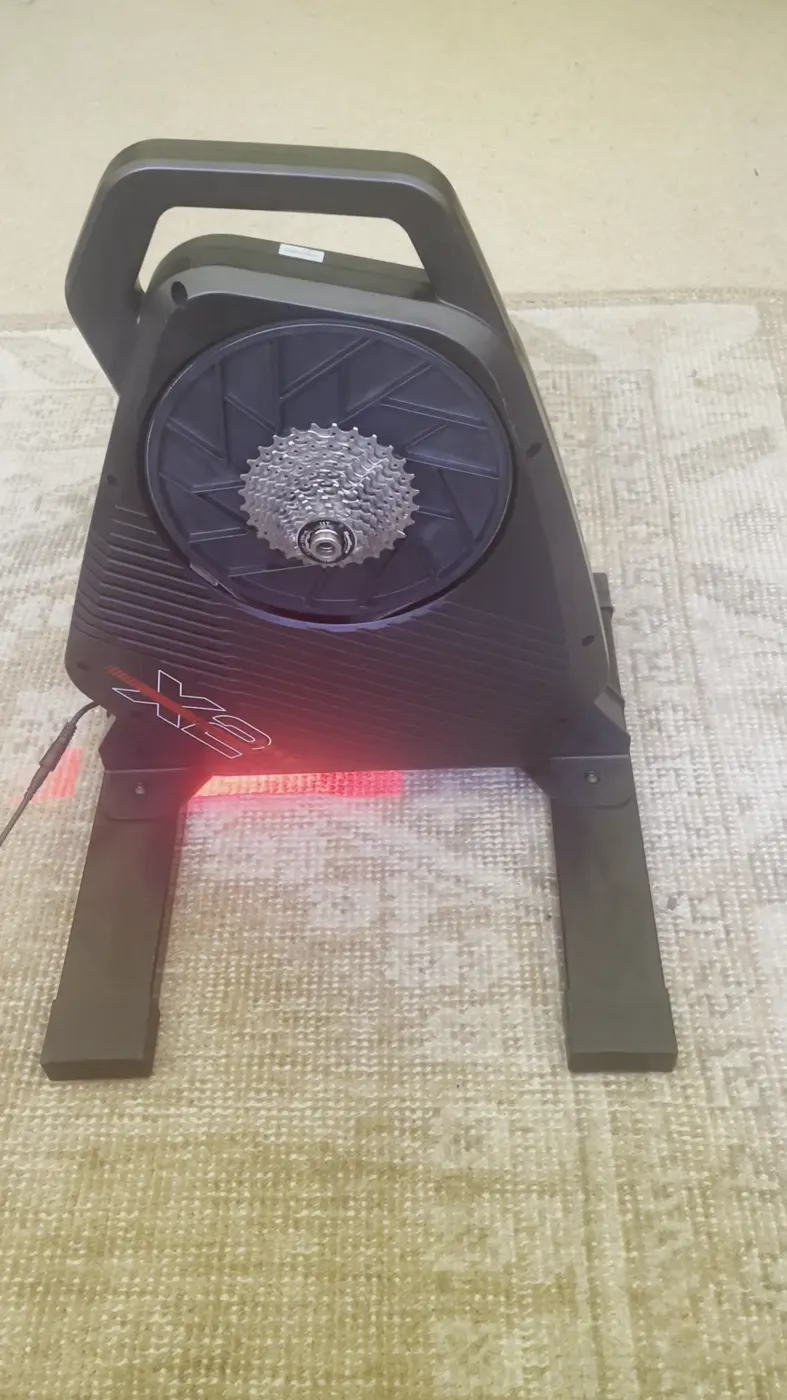
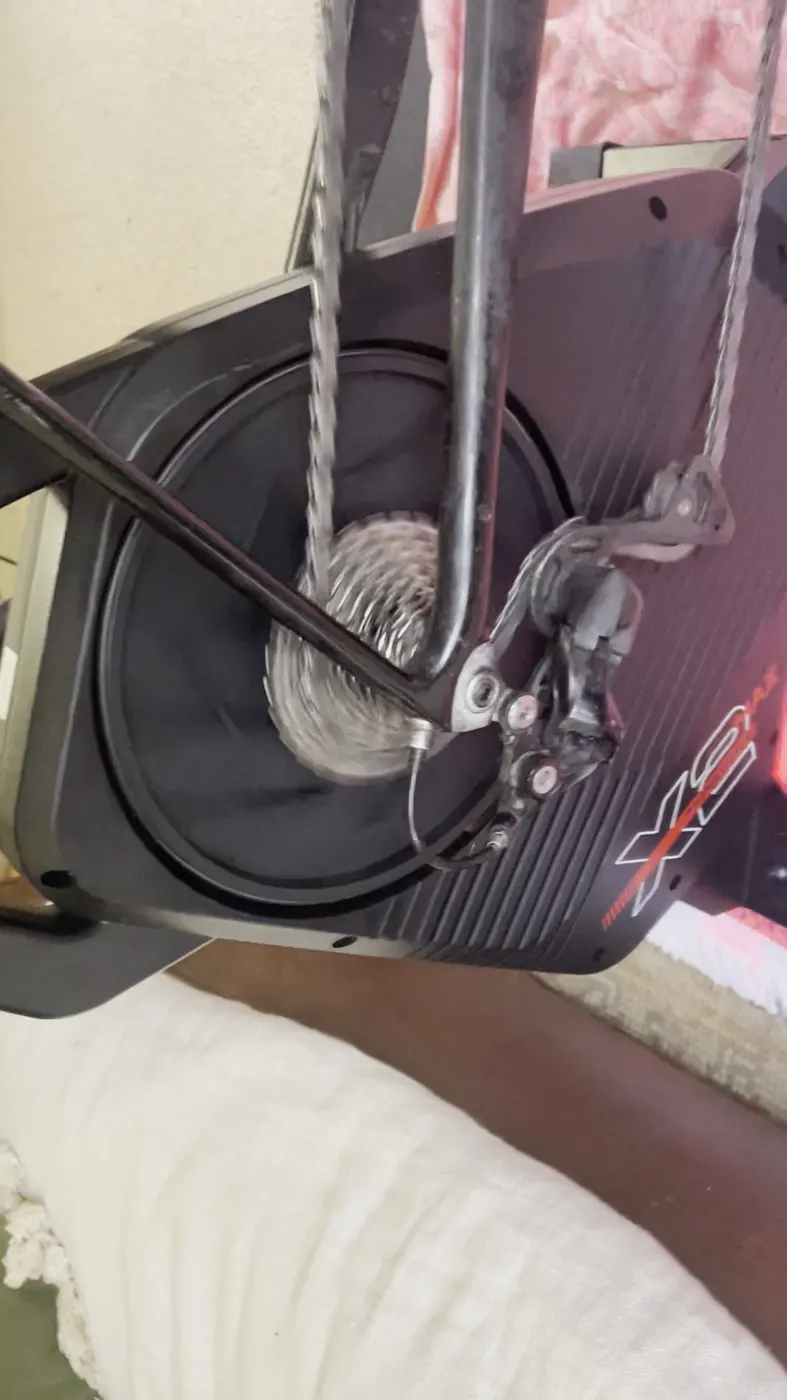
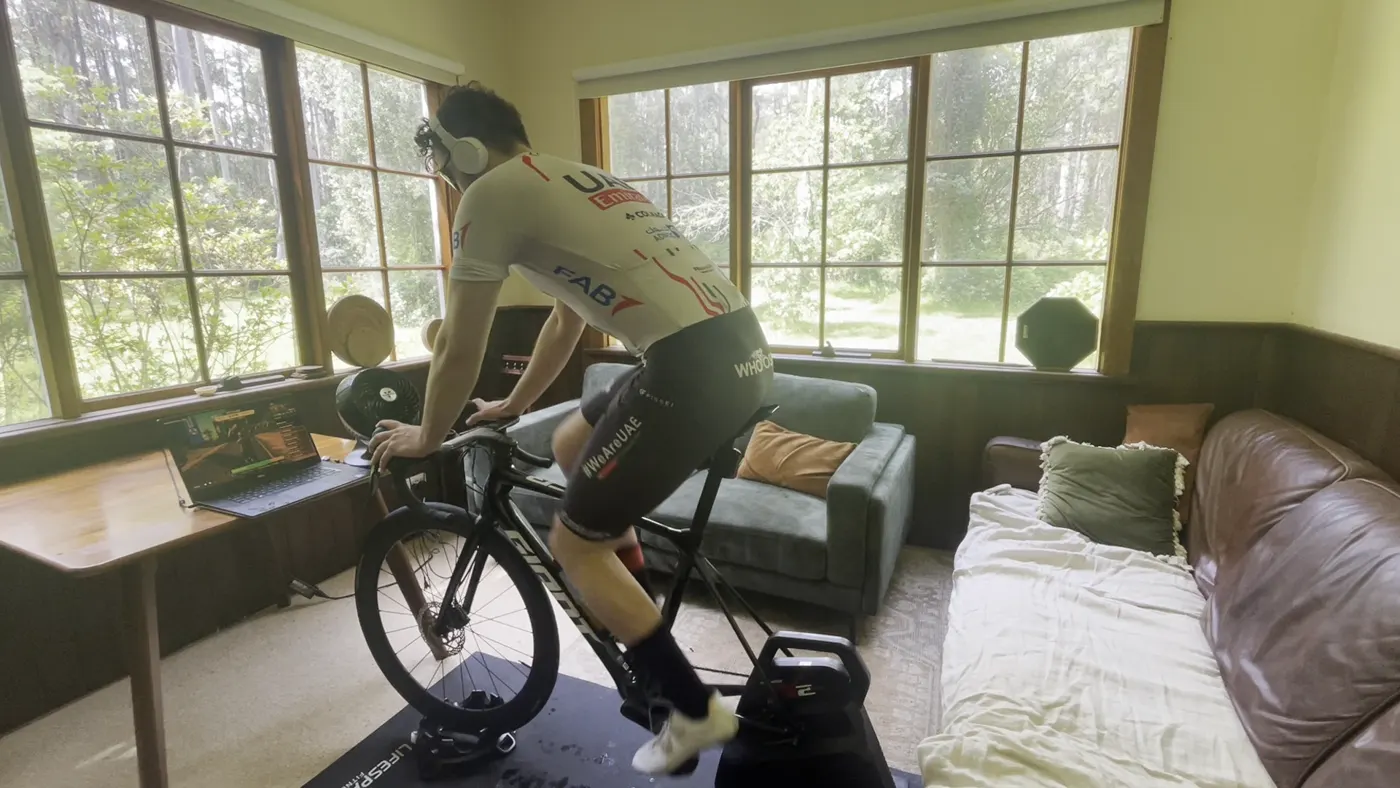
I've been riding the X2 Max on MyWhoosh for weeks. It's smooth and quiet, ERG mode works, and it handles sprints.
The trade-offs are real. There's no cassette in the box, ERG mode takes a second or two to respond, there's no downhill simulation, and support goes through the AliExpress seller.
It works with Zwift if you shift your real gears. It doesn't support Zwift's virtual shifting with the Zwift Cog and Click.
It weighs 16 kg and is listed at about 109 kg max rider weight, a bit under the KICKR Core 2's 113 kg. Check that if you're a bigger rider.
How accurate is the X2 Max?
Accurate enough to train with, but some units read high. ThinkRider claims ±2%, while owners on Reddit and forums report some read 10 to 15 W (about 5 to 10%) above their pedal power meters.
Owners also report power spikes when the gradient changes suddenly. The ThinkRider app has no calibration offset, so correct it in Zwift or MyWhoosh, or use your power meter as the power source.
If Zwift's calibration screen sits on "waiting for device", update the trainer's firmware.
Buy it if you want a real direct-drive trainer, you're happy shifting your own gears, and you'd rather spend the savings on a cassette and a fan. Skip it if you want Zwift virtual shifting, a local shop to take it back to, or you're over about 109 kg.
Is the ThinkRider XX Pro worth the extra money?
Only if you want downhill simulation, tighter claimed accuracy or a trainer that runs without a power outlet.
The XX Pro is ThinkRider's premium trainer, at about US$360. It's self-powered, claims ±1% accuracy and 2,500 W, and it can spin the flywheel to simulate descents. On paper it's close to trainers that cost US$1,500.
I haven't ridden one. The X2 Max does everything I need, so I've had no reason to upgrade. Like the X2 Max, it doesn't come with a cassette.
Buy it if descents or riding away from a power point matter to you. Skip it if you just want ERG workouts and climbs: the X2 Max does that for about US$140 less.
Is the Wahoo KICKR Core 2 worth double the price?
On raw numbers, no. It's worth it if you want Zwift virtual shifting, a cassette in the box, and a brand that makes warranty claims and resale easy.
I owned the original KICKR Core, and it was a solid, reliable trainer. I haven't ridden the Core 2.
The Core 2 is US$549.99 at full price, less in bundles and sales. Wahoo lists ±2% accuracy, 1,800 W, a 16% max grade, -10% downhill and a 113 kg rider limit.
The US version ships with an 11-speed 11-28 cassette, so there's nothing extra to buy. It's also officially supported for Zwift's virtual shifting with the Cog and Click, which none of the ThinkRiders are.
You still pay more than double the X2 Max for similar numbers. What you're buying is the Wahoo name: easy warranty claims, polished apps and a trainer you can sell later.
Buy it if you ride Zwift a lot and want virtual shifting, or you want a big brand behind your trainer. Skip it if you shift your own gears and train on MyWhoosh or TrainerRoad.
Is the Van Rysel D100 the cheapest smart trainer worth buying?
For lighter, casual riders who want Zwift virtual shifting from a shop with a returns desk, yes. For anyone who sprints or climbs hard, its 600 W ceiling rules it out.
Decathlon sells it for about €249 without a cassette, or €299 with a Zwift Cog and Click, and DC Rainmaker has seen it at €199 on sale. BikeRadar lists it at £259.99 with the Cog and Click.
DC Rainmaker calls it the best budget smart trainer for the price. BikeRadar found its power generally accurate and measured it at about 58 dB at 150 W (30 km/h), peaking at about 68 dB at 600 W.
The limits are real though. It tops out at 600 W and a 6% grade, and Decathlon only claims accuracy under ±5%. It's Bluetooth FTMS only with no ANT+ FE-C, which matters if you use an older head unit. DC Rainmaker lists no cadence, and BikeRadar found its cadence inaccurate.
I haven't ridden one.
Buy it if you live near a Decathlon, ride casually and want Zwift virtual shifting for the least money. Skip it if you race, sprint, love Zwift climbs or need ANT+. The X2 Max doesn't have those limits.
Should you still buy a Zwift Hub One?
Only new on clearance or second-hand in good condition, because Zwift has discontinued it.
It was one of the best budget trainers when it launched: 1,800 W, 16% gradient and a Zwift Cog included. Some independent tests found it read a few per cent lower than pedal power meters, so pair a power meter if you have one. I haven't ridden one.
Direct drive vs wheel-on: is direct drive worth the extra money?
Yes. Direct drive is quieter, more accurate and doesn't wear your tyre, and cheap direct-drive trainers now cost barely more than wheel-on smart trainers.
With a direct-drive trainer you take your back wheel off and mount the bike on the trainer's cassette. A wheel-on trainer presses a roller against your rear tyre instead, and that tyre contact is where most of the noise comes from.
| Direct drive | Wheel-on | |
|---|---|---|
| Noise | Drivetrain noise only | Adds tyre rumble that travels through floors |
| Tyre wear | None, the back wheel comes off | Wears your rear tyre |
| Accuracy and feel | Better, closer to riding outside | Worse |
| Extra parts | A cassette if one isn't included | None |
| Cheapest smart option | About US$220 (X2 Max) | Not much less |
Rollers are a different thing again, and this guide doesn't cover them.
Is a budget direct-drive trainer quiet enough for an apartment?
Usually, yes. A direct-drive trainer isn't silent, but it's far quieter than a wheel-on trainer, and what you hear is mostly your chain and drivetrain.
Owners on Reddit say the low-frequency rumble that bothers people downstairs comes from wheel-on trainers. One direct-drive owner can't hear theirs from another room with the door shut.
For numbers, ThinkRider claims the X2 Max runs at about 58 dB at 30 km/h. BikeRadar measured the Van Rysel D100 at about 58 dB at a similar effort and about 68 dB flat out at 600 W. My X2 Max is smooth and quiet on MyWhoosh.
In a flat with thin walls, put the trainer on a rubber mat. Riders recommend it to stop vibration going into the floor.
How do you choose a budget smart trainer?
Decide what you'll actually do on it, then check five things: total cost, max power, max gradient, Zwift virtual shifting and ANT+.
| What to look for | How the picks stack up | |
|---|---|---|
| Budget | Price plus a cassette if one isn't included | X2 Max about US$220 plus US$30 to US$60; D100 €249 to €299; KICKR Core 2 US$549.99 with a cassette (US) |
| Max power | Well over 1,000 W if you sprint | X2 Max 2,000 W; KICKR Core 2 1,800 W; D100 600 W |
| Gradient | 15% or more to climb in apps | X2 Max 18%; KICKR Core 2 16%; D100 6% |
| Zwift Cog | Only matters if you want Zwift virtual shifting | KICKR Core 2 and D100 support it; X2 Max doesn't |
| ANT+ FE-C | Needed for older head units and ANT+ setups | X2 Max has it; D100 is Bluetooth FTMS only |
Accuracy matters less than you'd think. For training, consistency from session to session matters more than the last 1%, and if you own a power meter you can use it as your power source in the app.
Most riders never get near 2,000 W, so don't pay extra for a bigger number. Watch the low end instead: a 600 W and 6% ceiling is where a cheap trainer starts holding you back.
Skip "dumb" trainers. I used an Elite Chrono fluid trainer for years before training apps took off. Without resistance control there's no ERG mode and no climbs, and I never stuck with it. A smart trainer is what makes indoor riding bearable.
What else do you need for a budget smart trainer?
A cassette if your trainer doesn't include one, a fan, a rubber mat, a towel and a training app, which can be free.
- A cassette for the X2 Max. It takes Shimano 8 to 12-speed HG and SRAM 8 to 11-speed cassettes, and SRAM XDR needs a separate freehub. Budget US$30 to US$60. The US KICKR Core 2 already has one.
- A fan. Riders on Reddit recommend one, because there's no wind indoors to cool you down.
- A rubber mat, to protect the floor and stop vibration reaching the neighbours.
- A towel for the sweat.
- An app. MyWhoosh is free and it's what I use. Zwift and TrainerRoad are monthly subscriptions.
Budget smart trainer FAQ
What is the best budget smart trainer in 2026?
The ThinkRider X2 Max, for most people. It's a direct-drive smart trainer with 2,000 W, 18% gradient simulation, ANT+ FE-C and Bluetooth for about US$220 on AliExpress, and it's the trainer I ride. If you want a big brand and Zwift virtual shifting, get the Wahoo KICKR Core 2 at US$549.99.
What is the cheapest smart trainer worth buying?
The ThinkRider X2 Max at about US$220, or Decathlon's Van Rysel D100 at about €249, or €299 with a Zwift Cog and Click. The D100 tops out at 600 W and a 6% gradient. The X2 Max goes to 2,000 W and 18%, so it suits stronger riders and anyone who likes climbing.
Is a direct-drive trainer worth it over a wheel-on trainer?
Yes. Direct-drive trainers are quieter, more accurate, don't wear your tyre and feel more like riding outside. Owners say wheel-on trainers add tyre rumble that travels through floors. Cheap wheel-on smart trainers now cost nearly as much as a US$220 direct drive, so the saving isn't worth it.
Is a direct-drive trainer quiet enough for an apartment?
Usually, yes. A direct-drive trainer isn't silent, because you still hear your chain and drivetrain, but it's far quieter than a wheel-on trainer. One owner on Reddit can't hear theirs from another room with the door shut. Put it on a rubber mat to stop vibration going into the floor.
What's the best budget smart trainer for Zwift?
If you want Zwift's virtual shifting with the Zwift Cog and Click, pick a trainer Zwift supports, such as the Wahoo KICKR Core 2 or the Van Rysel D100. If you're happy shifting your real gears, the ThinkRider X2 Max works with Zwift for much less money. It also works with MyWhoosh, which is free.
Do I need Zwift, or is there a free app?
You don't need Zwift. MyWhoosh is a free alternative, and it's what I ride on my X2 Max. Zwift and TrainerRoad are monthly subscriptions. You only need Zwift if you want its virtual shifting with the Zwift Cog and Click, and then you need a trainer Zwift supports.
Do budget smart trainers come with a cassette?
Some do. The ThinkRider X2 Max and XX Pro don't, so budget US$30 to US$60 for a cassette that matches your bike. The Wahoo KICKR Core 2 ships with an 11-speed 11-28 cassette in the US. The Van Rysel D100 and Zwift Hub One bundles come with a Zwift Cog instead.
Can I just use a cheap dumb trainer?
You can, but I wouldn't. I used an Elite Chrono fluid trainer for years and never stuck with it. Without resistance control there's no ERG mode and no simulated climbs, so every session feels the same. A smart trainer is what makes indoor riding bearable.
What else do I need for indoor training?
A fan, a rubber mat, a towel and a training app. Add a cassette if your trainer doesn't include one, which for the X2 Max means US$30 to US$60. MyWhoosh is free, so the extras can cost a lot less than the trainer.
My pick
If you don't train indoors every day and don't want to pour hundreds of dollars into a trainer, get the ThinkRider X2 Max. It's what I ride, and I have no desire to upgrade.
More: the full X2 Max review, cheap AliExpress bike upgrades and cheap aero upgrades.
Sources
- Wahoo: KICKR CORE 2 tech specs: US$549.99, 1,800 W, 16% to -10% grade, ±2%, 113 kg max rider, 11-speed 11-28 cassette in the US listing.
- ThinkRider: X2 MAX product page: official specs (2,000 W, 18%, ±2%, 16 kg, about 58 dB at 30 km/h, cassette compatibility).
- MyBike.parts: ThinkRider X2Max owner reviews: owner reports on accuracy, noise and durability.
- BikeRadar: Van Rysel D100 review: £259.99 / €299.99 with Zwift Cog and Click, noise measurements, power and cadence accuracy.
- DC Rainmaker: Decathlon Van Rysel D100 in-depth review: pricing, 600 W and 6% limits, claimed accuracy, Bluetooth FTMS only.
Every weight, price and ride impression without a source is from my own bike, my own scale and my own receipts.